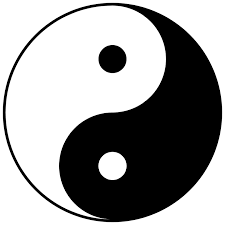
Nothing is God
Kierkegaard says that man must make an either/or choice between reason and faith. Man cannot have a middle way but must choose: it is either reason or faith, either the world of the senses (the aesthetic world) or that of God. Moreover, man has no criteria for making this choice. Faith and reason oppose each other, and man must choose: either with God or without God. Man must choose between God and, shall I say, nothingness (this is the world of the senses without God.)
What if there is nothing?
There is a comfort in the nothing. No thinking. No feeling. No pain. No suffering.
Perhaps this is not an either or or choice. Perhaps the concept of God and the Nothing are actually one?
The Nothing has been a perennial topic in the philosophy of metaphysics. For example, the ancient philosopher Parmenides believed that only Being is intelligible and the concept of Nothingness cannot even be thought, hence it is meaningless. Other philosophers thought that space itself is Nothingness. Like most metaphysical questions, the answer has not been agreed upon, remaining unresolved. Martin Heidegger also accepted the question, in fact his “preoccupation with the Nothing becomes an important theme that bridges his earlier and later works and serves to characterize his unique approach to philosophy.” [1]
In his 1929 essay, What is Metaphysics?, Heidegger submits that the Nothing is the basic question of metaphysics, which he reframes as “why are there beings at all, and why not rather nothing?” [2] The Nothing is a metaphysical problem, a problem that transcends physics, and as “every metaphysical question always encompasses the whole range of metaphysical problems” [3], the question of Nothing is intimately related to Being. Since “metaphysical inquiry must be posed as a whole and from the essential position of the existence (Dasein) that questions” [4], we must insert ourselves, Dasein, into any metaphysical question. As the question of the Nothing puts us, the questioners, in question, it is also a question of Being, a metaphysical question.
Science and logic are not equipped to address this metaphysical issue. Science analyzes beings as entities so Being itself is not an issue for science, it is not an ontological problem, it is an ontical problem. Fundamental ontology is not important to the sciences, nothing takes precedence or forms a basis for the various sciences and “science wishes to know nothing of the Nothing.” [5] Science doesn’t consider the environment it finds itself in, strictly concentrating on the subject object relationship. Our intellect (science) simply cannot grasp the whole (aka the Nothing) because it finds itself a part of the whole. It is human beings (Dasein) that pursue science, so we must understand ourselves, what Dasein is, what Being is, because Dasein itself is a mode of being. Any scientific investigation, be default, brings our subjective feelings into play.
Logic is also insufficient to investigate the Nothing. For example, a logical method of analysis would present a statement such as ‘the Nothing’ is x. This implies that the Nothing is something…a senseless and illogical statement. Logic forbids in principle any logical claim about the Nothing, both the “question and answer a like are inherently absurd.” [6] In fact, Rudolf Carnap famously wrote a takedown of Heidegger claiming the Heidegger is speaking nonsense. As soon as science starts to talk about the Nothing it logically turns it into something, our minds (hence science and logic) can’t grasp this dissonance and thus ignores it. Our limited cognition can’t comprehend the concept of the Nothing, it is simply beyond our mental grasp. The Nothing can’t be observed so science can’t investigate it. Our senses, reason, logic have no access to the Nothing. How then do we proceed? The nothing must be experienced through a feeling or mood.
The world is seen and experienced differently based on the state of one’s mind or feeling, mood alters Dasein’s phenomenological experience of the world, of reality…of Being itself. Thus moods have a metaphysical significance. Access to the whole, the Nothingness, is not through intellect or reason, but through thoughts, feelings, moods. Intellect cannot perceive ‘the whole’ as mood can. Moods color our relationship to the whole, to everything. As mentioned in the introduction to the essay, “Dasein is disclosed in such moods in which a man finds himself such as joy, boredom, excitement, or anxiety.” [7] Affected states such as boredom, joy, love, sadness, suffering and fear all change our perception of Being. Feelings alter our phenomenological experience and Heidegger wants to use this property of the mind to understand the Nothing. He feels there is a “correspondingly original mood in which the proper sense of unveiling reveals the nothing” [8] and that mood is anxiety.
Anxiety, unlike fear, which is fear of a particular, is fear of the whole, a form of complete mental paralysis where “all things and we ourselves sink into indifference.” [9] Fear is about something, whereas anxiety is about Nothing. It is essential to our very being that we face up to this anxiety, which is not a pathology, but a part of being a person, an integral component of Dasein. Heidegger submits that during the fundamental mood of anxiety everything loses its relevance. “In anxiety, dasein finds itself face to face with the nothing of the possible impossibility of its own existence.” [10] During this sense of total indifference to the world and ourselves, we are attuned to the Nothing. Anxiety is a relationship with the nothing, a state of disturbance about Nothing. “Anxiety reveals the Nothing.” [11] This feeling of true anxiety, the fear of Nothingness, silences thinking, we cannot engage with the world. As such, the intellect is incapable of grasping what can be achieved through feeling, no thought can capture what you are experiencing. Feeling thus surpasses the intellect.
When grappling with this feeling of anxiety while perceiving the Nothing, in experiencing the Nothing, we indubitably experience pure Being as well. Being emanates from the Nothing, “only on the ground of the original revelation of the Nothing can human existence approach and penetrate beings.” [12] Heidegger agrees with Georg Hegel in that “pure Being and pure Nothing are therefore the same.” [13]
Nothingness is not conceived of as a void, the Nothing is not the opposite of being, it is not negation, it explains negation. The Nothing is a precondition for negation, a precondition for science, logic and for Being itself, since all spring from the Nothing. “The Nothing comes to be a name for the source not only of all that is dark and riddlesome in existence – which seems to rise from nowhere and to return to it – but also the openness of Being as such and the brilliance surrounding whatever comes to light.” [14] Nothingness is the point where subject and object no longer exist so no scientific experiment could support the hypothesis ‘there is nothing’ because any observation obviously implies the existence of an observer. To imagine a world without perceiving subjects is impossible since we cannot escape our mind. There is no object without a subject. The condition for the possibility of existence, the eidetic intuition of the essence of Being is the Nothing. Being and nothingness are ultimately the same. Being is simply the phenomenological distinction of the Nothing. As such, “Being itself is essentially finite and reveals itself only in the transcendence of Dasein which is held out to the Nothing.” [15]
Experiencing the ultimate irrelevance of all things (the Nothing) through anxiety provides the opportunity for transcendence, the freedom to choose to create a new reality for yourself. Since authentically facing this anxiety is an integral part of Dasein, Dasein is transcendent. Without the original revelation of the nothing, no selfhood no freedom.” [16] To repress this anxiety would be to live inauthentically. To flee anxiety through suicide or by anchoring meaning in something given, such as religion, leaves no room for change, no room for transcendence, hence no Dasein. This notion of transcendence is a core concept of the Guignon and Pereboom essay on Existentialism. To be a human is to always have the possibility to transcend the distance from the way you are to the way to want to be. This distance is transcended by experiencing the Nothing. Realization of the total irrelevance of the Nothing is breaking free from our instincts, disengaging from the world to make it irrelevant and then launching back into the world to create, to transcend to what you choose to be. The possibility of freedom is anchored in the feeling of the nothing. Free will emerges from the Nothing.
The nothingness is unfathomable and ineffable not because it lacks meaning but because every possible meaning that there ever could emanates from the nothing, existence itself, Being. Why is there something rather than Nothing? Being and Nothingness are ultimately the same! The nothing is not emptiness but complete fullness, pure potential without dimensions, without time without any differentiation, complete unity…the whole of reality….some may say God.
[1] Heidegger, Martin. Introduction to metaphysics. Excerpt from Canvas, 2021, 91.
[2] Ibid., 110.
[3] Ibid., 93.
[4] Ibid. 94.
[5] Ibid., 96.
[6] Ibid., 97.
[7] Ibid., 90.
[8] Ibid., 100.
[9] Ibid., 101.
[10] Ibid., 90.
[11] Ibid., 101.
[12] Ibid., 103.
[13] Ibid., 108.
[14] Ibid., 91.
[15] Ibid., 108.
[16] Ibid., 103.