What is self?
What is the self? Who is the person that you talk to when you talk to the person in your head? These questions seem so banal that many never seriously consider them. Based on reading and analysis of Emerson’s essay, Self-reliance, George Mead’s essay, The ‘I’ and ‘me,’ and James Campbell’s introduction to George Mead, I will attempt to interpret Emerson’s and Mead’s contrasting yet complementary answers to these questions.
The self is a symbiosis of both the ‘I’ and the ‘me,’ a balance of the internal and the external, of the individual and the collective, the confluence of each in constant juxtapose to each other. There is a somewhat stochastic relationship between the two, their alternating influence on the identity of the self in continuous flux, governed by various factors such as environment, experience, intellect, upbringing, social caste and genetics. While both authors agree that the self is a combination of the ‘I’ and the ‘me,’ Emerson seems to emphasize the importance of the individual while Mead emphasizes the importance of the collective as the primary essence of self. I will support this view with evidence gleaned from the readings mentioned, followed by a discussion of this concept’s current pragmatic relevance.
To begin with, working definitions of the ‘I’ and ’me” are in order.
According to Meade, the ‘I’ is “the response of the organism to the attitudes of the others”[i] and the ‘me’ is the “phase of the self that contains the values and traditions of one’s own society,”[ii] created via social interaction, especially influenced the utilization of language. The ‘I’ and ‘me’ then merge and the ‘I’ really appears experientially as a part of a ‘me’.”[iii] I interpret this as that the ‘I’ is how an individual sees himself and the ‘me’ is how society perceives that individual.
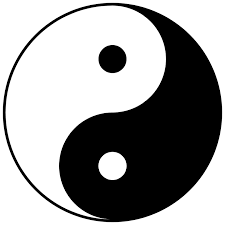
The ‘I’ and the ‘me’ are analogous to the yin and yang of Daoism, in that they are complementary, each requiring the other to exist. This assertation is supported by Mead’s view that “the two are separated in the process but they belong together in the sense of being parts of the whole, they are separated and yet they belong together” [iv] and exhibit “a fluid mutuality in which the relative values of the ‘me’ and the ‘I’ depend very much on the situation.”[v] In Daoism, a path to self-completeness, to individuation, incorporates the yin (feminine traits) with the yang (masculine traits). Both Emerson and Mead’s descriptions of self-incorporates the ‘I’ and the ‘me’ in a similar way.
Mead confusingly asserts that “the ‘I’ is not a ‘me’ and cannot become a ‘me’”[vi] however in the next sentence he conversely expresses that “they are both selves.”[vii] This seemingly paradoxical summation illustrates first a separation followed by a confluence between the two, suggesting that the self is the emergence of the complementary essences of the ‘I’ and the ‘me.’ The ‘I’ is continuously morphing into the ‘me’ hence “the ‘I’ of this moment is present in the ‘me’ of the next moment.”[viii]
Mead emphasizes the ‘me’ over the ‘I’ as evidenced by his view that “we humans are, first of all, social in our innermost being, emergent from and thrivers within the social process”[ix] and “for Mead the human self is fundamentally social.”[x] In contrast with Meads focus on the ‘me,’ Emerson emphasizes the importance of the ‘I’ over the ‘me.’
Emerson indirectly has a similar definition of the ‘me’ as Mead when he describes the conformist as one who “does not live in the present, but with reverted eye laments to the past, or heedless of the riches that surround him, stands on tiptoe to see the future. He cannot be happy and strong until he too lives with nature in the present, above time.”[xi] Emerson, however, stresses originality over conventionality with his declaration that “every great man is unique” and to “insist on yourself; never imitate.”[xii] The title of the essay alone, Self-reliance, indicates a focus on the ‘I’ instead of the ‘me.’ In emphasizing the individual over the collective, Emerson heeds us to think for ourself, despite the professed opinion of others; “what I must do is all that concerns me, not what other people think.” [xiii]
Original independent thinking is not only the courageous path but a pragmatic path as well, as exemplified by Emerson’s submission that “to believe your own true thought, to believe that what is true for you in your private heart is also true for all men – that is genius. Speak your most latent conviction, and it shall be the universal sense; for the utmost in due time becomes the outmost.”[xiv] If one can genuinely believe that one’s own opinion is also the path that is best for all men, it is not only a demonstration of sagacity, the table is set for the individual conviction to be manifested into reality, with help the collective!
Ironically, much of the collective may be thinking the same thing but are too fearful to express it, “the moment he acts for himself, tossing the laws, the books, idolatries and customs out the window, we pity him no more but thank and revere him.”[xv] Paradoxically, while rewarding conformity, society admires a free spirit. One who bucks the rules and does things their own way, not only refusing to bow down to the ruling class but giving them the middle finger, is venerated.
It is difficult to choose the individualistic path, fitting in and going with the flow is easier than rowing against the current. One pays a severe price for non-conformity; it is not for the weak or the meek because unconventionality can be viewed as a threat to peoples basic belief systems as “the populace think that your rejecting of popular standards is a rejection of all standards”[xvi] and “for non-conformity, the world whips you with displeasure.”[xvii] It takes patience and courage to exhibit individuality. Like the confluence of two rivers which flow into one, in the self, there is much turbulence. Even when the ‘I’ and the ‘me’ merge, each may flow at different levels and sometimes in opposition to each other as when the wind blows the opposing direction of tidal forces.
I interpret Emersons view in general and specifically as evidenced by the passage “a man should learn to detect and watch that gleam of light which flashes across his mind from within, more than the lustre of the firmament of bards and sages”[xviii] as a dictate to embrace originality over conformity, to be proud of your sentiments and to value original thought over acquired knowledge.
Emerson professes that as we are manifestations of God, our individuality is itself also an expression of God and we should not be “ashamed of that divine idea which each of us represents” and “God will not have his work manifest by cowards.”[xix] A possible critique of Emerson’s view that individuality (the ‘I’) is an expression of God, is that collectivism (the ‘me’) is also an expression of God. God created the sheep as well as the sheep herders and I couldn’t clearly ascertain Emerson’s justification for why God has preference for individual thought over groupthink.
Who we are, the self, is actually a balance of the ‘I’ and the ‘me.’ The ‘I’ converses with the ‘me’ when conscious internal dialogue occurs. A human being is both a product of society and an individual essence. The whole person is one who is able to successfully integrate the ‘I’ with the ‘me’ without harmful dichotomy between the two as cognitive dissonance between the ‘I’ and the ‘me’ leaves one feeling incomplete. The notion that something is missing that can’t be identified is the individualist lacking social integration and/or the conformist lacking originality. The symbiosis of the ‘I’ and the ‘me’ is a fluid and never-ending process; “as human individuals, we remain in process as long as we live. We continue to develop and change, to expand and contract.“[xx]
This topic is relevant today because groupthink, pressure to conform to the majority view, dominates our social discourse.
Free speech, the right to individualistic expression (represented by the ‘I’) despite the opinions of the majority and/or those in control of society, is the foundation of a free society. However, the fact that social validation (represented by the ‘me’) is a critical factor of self-esteem and of being a human being must be balanced with the fact that the ‘social contact’ breeds conformity as Emerson confirms that “society everywhere is in conspiracy against the manhood of every one of its members” and “the virtue in most request is conformity.”[xxi] Conformity is safe. Compliance and following the rules is viewed as the moral things to do, possibly confusing morality with legality. Obedience to the dictates of society is viewed as beneficial.
However obedience threatens the sense of self (‘the ‘I’), the freedom to make one’s own choice. Both on the right and the left, any that don’t espouse and conform to the majority view are vilified and become targets of the growing and pervasive ‘cancel culture.’ Dissenters are viewed as enemies. A conflicting view on a single issue, condemns all the views of the person presenting the view. If one doesn’t adhere to ALL ideals of the tribe, ostracization is their destiny. The ‘me’ is susceptible to sometimes nefarious influences of the opinion of the collective, creating a danger of cognizant dichotomy for the self.
Who am I? What is my self-identity? One way to look at this that I am the sum of my parts. Physically this could consist of a bunch of chemicals or a bag of skin filled with vital organs. Another perspective is that the self is an integration of mind and body, and delving deeper, the mind is an integration of the ‘I’ and the ‘me.’ There is what others see me as, the ‘me,’ and there is what I see myself as, the ‘I.’ Once these delineations are taken into account, the self seems to be an emergence with the aggregate actually becoming more than the sum of all the parts. When these “parts” are integrated in a certain way with each other and the environment, the self emerges, the self at that microcosm of time, since many of the influences which consist of the self are ever evolving. The you who started reading this essay is not the same you as is reading it now.
Works Cited
[i] Charles W. Morris, Mind, Self, and Society from the Standpoint of a Social Behaviorist (Chicago: Univ. of Chicago Press, 1934), 547.
[ii] Ibid.
[iii] Ibid.,590.
[iv] Ibid.,591.
[v] Ibid.,547.
[vi] Ibid.,589.
[vii] Ibid.
[viii] Ibid.
[ix] Ibid.,545.
[x] Ibid.
[xi] Ralph Waldo Emerson, The Essential Writings of Ralph Waldo Emerson Essay (New York: Random House, 2000), 143.
[xii] Ibid.,150.
[xiii] Ibid.,136.
[xiv] Ibid.,132.
[xv] Ibid.,147.
[xvi] Ibid.,146.
[xvii] Ibid.,137.
[xviii] Ibid.,133.
[xix] Ibid.
[xx] Charles W. Morris, Mind, Self, and Society from the Standpoint of a Social Behaviorist (Chicago: Univ. of Chicago Press, 1934), 545.
[xxi] Ralph Waldo Emerson, The Essential Writings of Ralph Waldo Emerson Essay (New York: Random House, 2000), 134.